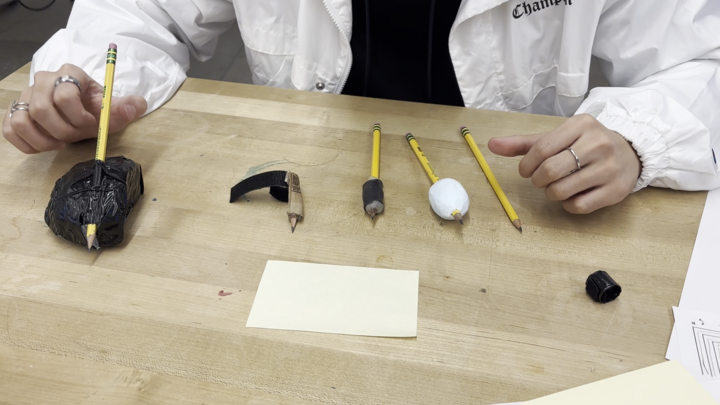
Figure 1: Overview of the 5 different low-fidelity prototypes created for alpha release. From left to right they are the mouse pencil design, finger pencil design, redesign the pencil design, pencil grip design, and finger sleeve design.
The splartz chosen by my team (Ryan Qian, Kane Pan, Ellie Kim, and Kimmy Tran) was to create a design to alleviate writer's callous, which is the callous that often forms on the finger used to press a writing utensil (most commonly the middle finger). The goal of this project was to create 5 designs, and prototype them to present to our TAs. Following the presentation, our next steps were to converge to a single proposed design. Throughout this project, my team used lotus blossom to initially generate the 5 designs shown in Figure 1, then we used low fidelity prototyping to represent the designs, and finally we use pairwise debates to converge to a single design. The following discussion is dedicated to understanding the usefulness of each CTMF described.
Lotus Blossom Method - Diverging
The lotus blossom method is a brainstorming/diverging tool that is used to create a large number of ideas based on a central idea or theme. My team found this tool the most effective as it allowed teammates to discuss and build off eachother easily, while promoting creativity and discussion. Figure 2 containes a graphic of the brainstorming done using the lotus blossom method. I believe this tool was especially effective in our context, as our design project was centralized around finding alternative designs to writing with a pencil, thus the lotus blossom method shined as it focuses on maintaing connection to the central ideas. The lotus blossom method's unique trait compared to other diverging tools, is that it remains connected to the central idea, thus I believe this tool is best used when the design project is orientated towards creating alternative designs or improving on current designs.
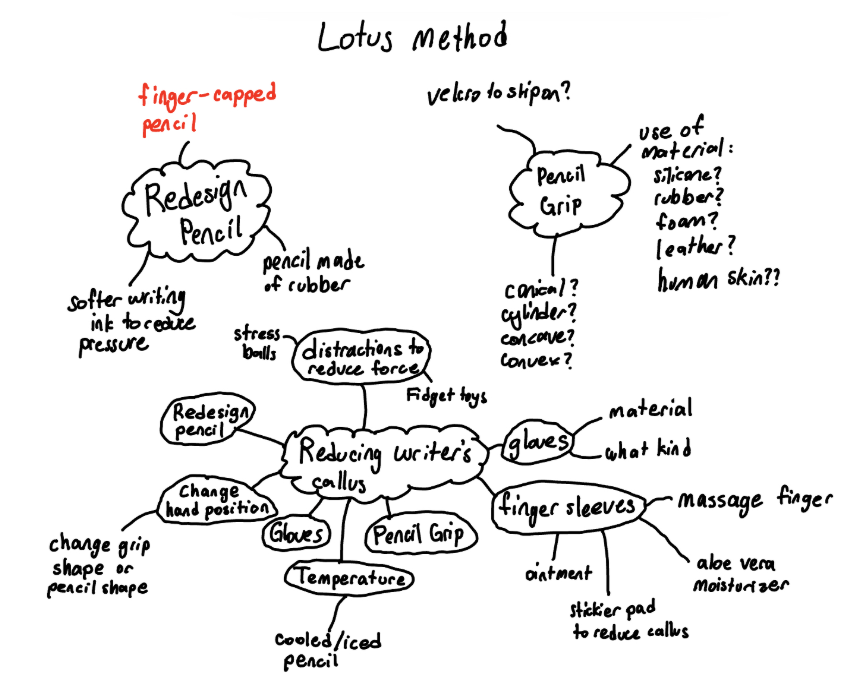
Figure 2: Graphic of the produced lotus blossom made in studio to diverge solutions. The center of the lotus is labelled "reducing writer's callous".
Low Fidelity Prototyping - Represent
Low fidelity prototyping was used in the representation of the diverged designs. Figure 1 contains the five produced physical low fidelity prototypes, while Figure 3 contains an in depth explanation of the finger pencil prototype and design. Low fidelty prototyping was an ideal approach to representing the designs, as the goal of the representation was simply to communicate what the design was, and not to represent the functionality and technical aspects of the design. Low fidelity prototyping was effective in this low stakes context of this design project, however I would be skeptical of its effectiveness in communicating technical aspects and the true functionality of a design. Thus, I only recommend using this tool to portray extremely basic initial prototypes to show the shape and form of a design.
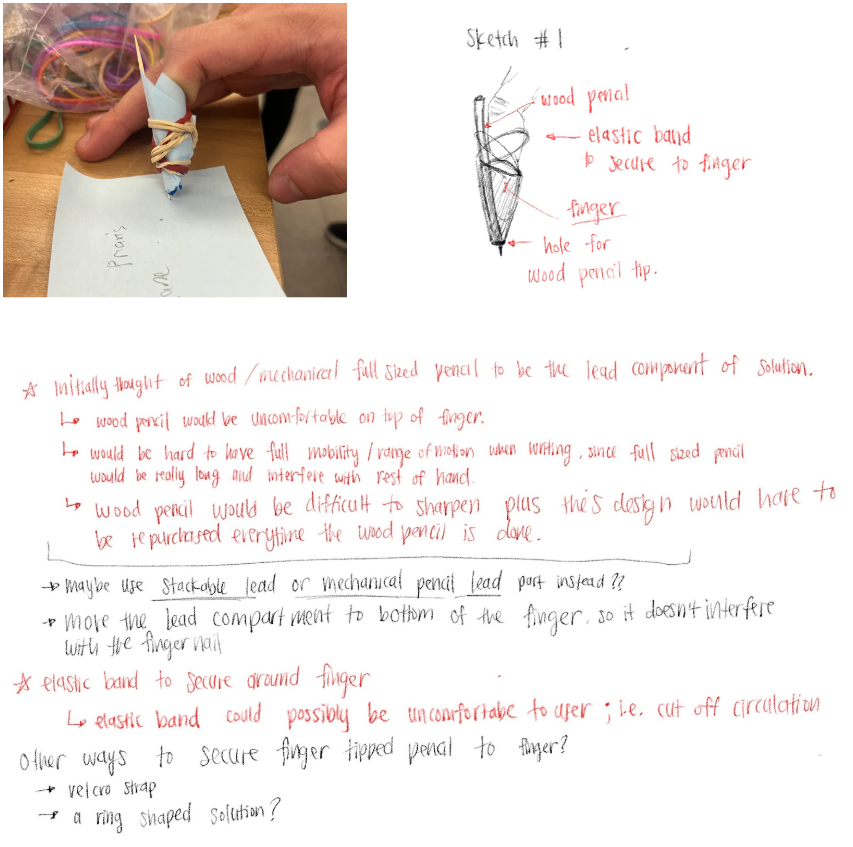
Figure 3: A graphic showing the low fidelity prototype created for the finger pencil design. In the top left is an image of the first physical low fidelity prototype. The rest is a textual explanation of the prototype.
Pairwise Debates - Converging
Following the presentation of the low fidelity prototypes, it was time for my team to converge to a single prototyped design. Throughout the converging process, pairwise debates were found to be the most effective converging tool. Figure 4 contains a graphic showing my team's use of the pairwise debate CMTF. The pairwise debate was effective in our context, as our designs were largely simplistic and intuitive to understand, thus easy to compare and debate over. Thus, we were able to quickly identify strengths within each design and intuitively identify the best of the designs. As an additional bonus, the pairwise debate can strengthen teammate bonds as team orientated interactive social tool. The limitation of this tool is that if the designs are extremely complex and difficult to understand, the pairwise debate loses effectiveness, due to its reliance on quick intuitive arguments to come to a conclusion. Futhermore, this tool does not document the degree to which and reason for one design losing over the other, which can lead to overestimating/underestimating designs. Thus, I would only recommend this tool when working with simple and minimalist designs.
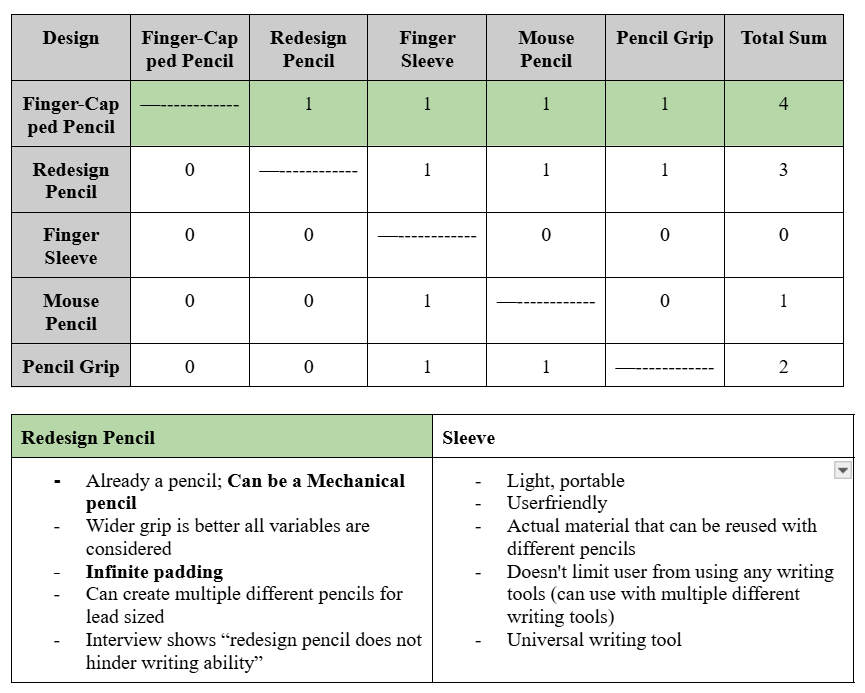
Figure 4: A graphic showing the pairwise debate process. The top table shows the scores of each design after being debated with each other design. In the bottom left shows the pros of the redesign the pencil design, and in the bottom right shows the pros of the finger sleeve design. Green indicates dominancy over the other design(s).